
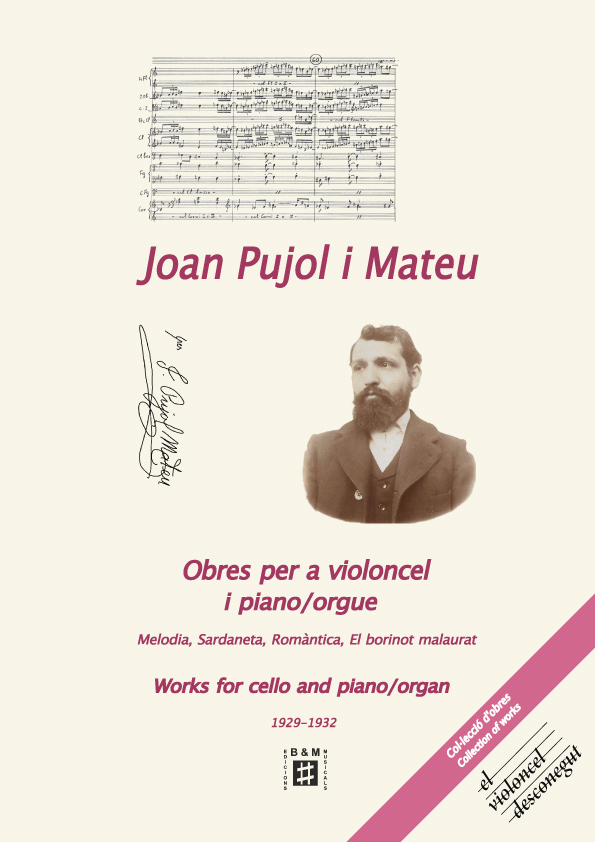
Description
Author
Instrumentation
Duration
Pages
Year of composition
ISMN
Ref.
This edition of Joan Pujol i Mateu’s four works for cello is based on the manuscripts preserved by the Centre de Documentació de l’Orfeó Català (Documentation Centre of the Orfeó Català – CEDOC) in its Fons Joan Pujol Mateu (Joan Pujol Mateu collection). Joan Pujol’s daughters donated these scores to the CEDOC in December 1953 in accordance with their father’s wishes.
Melodia per a Violoncell (Estil segle XVII) is the earliest of the four and bears two composition dates. The date of January 1929, written in pencil, seems to correspond to the draft, whereas the date 1930, which we understand to be that of the definitive version, appears in ink under the signature on the first page. The piece is written for cello to an accompaniment for Romantic organ, though it can also be accompanied on the harmonium or piano. The indication “17th-century style” points to Joan Pujol’s —somewhat fantastical— desire to evoke the Baroque spirit. It is a highly expressive, lyrical piece with religious overtones.
Next comes Sardaneta per a Violoncell i piano, a fresh, lively work composed in December 1931. As the title suggests, it features the typical structure and motifs of the sardana.
The following piece is Romàntica, peça musical per à Violoncell i Piano, a musical piece for cello and piano which bears the composition date 1932. With a structure characteristic of a ternary Lied, it is, as the title suggests, highly expressive.
The fourth and last piece is El borinot malaurat, which is subtitled Allegro caracteristic per a Violoncell. It too was completed in 1932. The title, which reveals an endearing sense of humour, is reminiscent of The Flight of the Bumblebee by Rimsky-Korsakov, an instrumental fragment of the opera The Legend of Tsar Saltan which has often been arranged for various instruments, as well as for cello with a piano accompaniment. Pujol took the musical idea from a melodic line comprising numerous notes to imitate the buzz of the flying bumblebee. The adjective “unhappy” undoubtedly explains the unexpected rhythmic irregularities of the cello.
Marc Renau and Marta Augé


There are no reviews yet.