
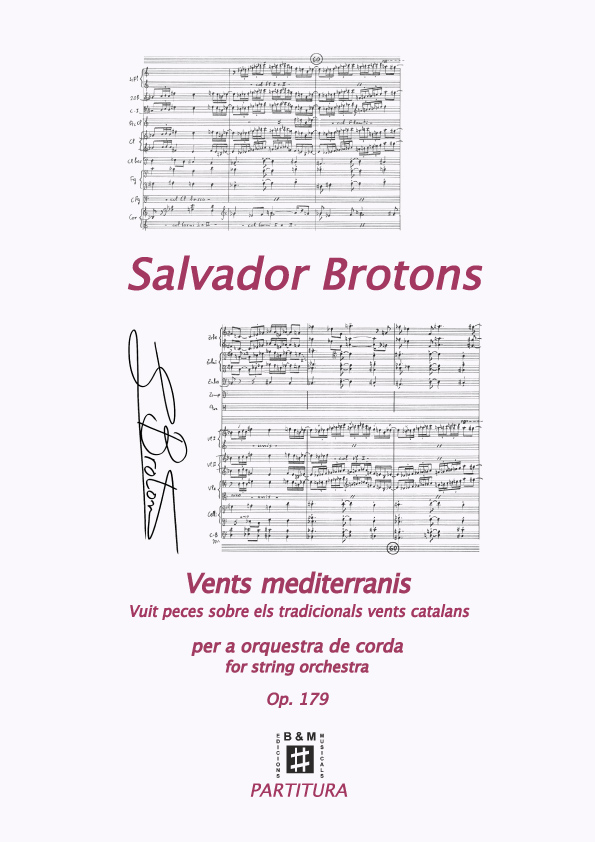
Description
Author
Format
Instrumentation
Duration
Pages
Year of composition
ISMN
Ref.
I – Ponent (West wind)
II – Garbí (Southwest wind)
III – Llevant (East wind)
IV – Migjorn (South wind)
V – Mestral (Northwest wind)
VI – Gregal (Northeast wind)
VII – Xaloc (Southeast wind)
VIII – Tramuntana (North wind)
I have always had a great passion for winds. I was practically born in Port de la Selva, in the far north of the Costa Brava at the Norteast of the Iberian peninsula, where all the winds blow with great force, especially the hurricane-like Tramuntana. Looking at the drawing of the «Wind Rose», I have always been fascinated by the popular names given to our winds, so poetic and beautiful, according to the direction from which they come. Thus, for some time I had had in mind the idea of composing a work inspired by the names and character of our winds. It was during the summer of 2026 that, without any urgent commissioned composition to complete, this piece for string orchestra emerged, composed in one continuous burst in less than three weeks.
Each movement seeks to describe the character of each wind: some more aggressive, others more dangerous, heavy, calm, and so on, always seeking variety and unity in a work driven by the agitation of the great Mediterranean Sea. The order of the movements is presented solely for reasons of contrast.
The Ponent is a feared wind along our coasts, as it blows from the land out to sea. If you are at sea when the Ponent comes in, you may have great difficulty getting back home. The music therefore suggests fear, agitation and eerie effects, all within an enigmatic and turbulent movement of waves.
The Garbí is a gentler south-westerly wind and is based on the Catalan song «La calma de la mar» (“The calm of the sea”), which includes the words: «Bufa, ventet de garbí» (“Blow, little Garbí wind”). The music is gentler and tonal, filled with a pleasant rocking motion.
The Llevant brings heavy rain and destruction. Llevantada storms are greatly feared by everyone. The pizzicato at the beginning represent the rain, which later develops into an unleashed storm in a movement full of energy and activity.
The Migjorn is a heavy southerly wind. It comes from the African desert and always brings heat and a sense of weight. The music is slow, with moments of agitation created by the irregular rhythms of the violas. Towards the end, a storm of sand and mud can be perceived.
The Mestral is a dry, strong and cold north-easterly wind. It is very similar to the Tramuntana. Its aggressiveness is intense and can be difficult to endure. The accents and dissonances in the music create unstoppable dynamism and power.
The Gregal is a fresh and pleasant north-easterly wind. It comes from the mountains, and this is why I found inspiration in the traditional song «Muntanyes regalades». The music is gentle and pleasing, with several sudden tonal changes.
The Xaloc is a south-westerly wind and is therefore rather heavy. The solos for double bass, viola and cello reflect this slow and restful atmosphere. In the short central section, ricochet bowing effects introduce a touch of agitation.
The Tramuntana is the most distinctive wind of our region, and one that we even look forward to at times. Fresh, sometimes icy, aggressive, powerful, dry and very healthy, it is especially welcome in summer, when the heat becomes overwhelming. The music tells this story to perfection. The central section is based on the traditional song «El mestre», which, together with the fragrant atmosphere of the wind, identifies us with what we are and will always be: a great free people.
The composer authorises this piece to be performed partially if, for programming reasons, this is desired.
Salvador Brotons


There are no reviews yet.