
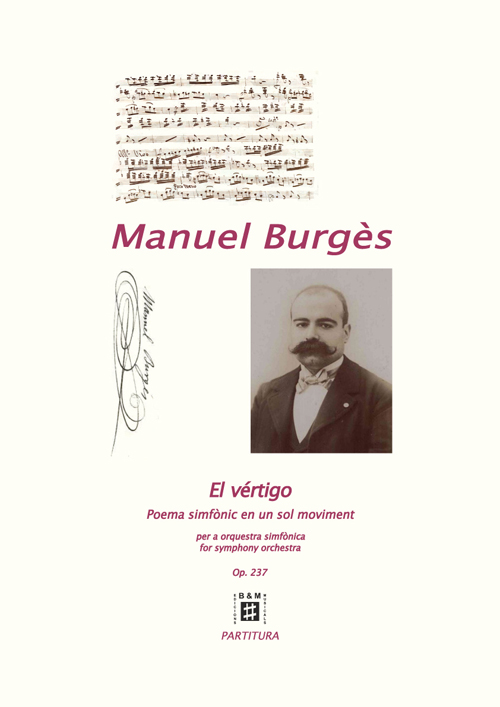
Description
Author
Format
Instrumentation
Plantilla
Duration
Pages
Year of composition
ISMN
Ref.
This is a programmatic work inspired by a poem by Gaspar Núñez de Arce, a Castilian politician and writer. A symphonic poem lasting approximately 25 minutes, this piece has moments of great drama, with plaintive chromaticism in the strings and strong timbral contrasts between the wind, brass and string sections. Other sections, on the other hand, consist of a subtle lyricism conveyed by the two harps, the pianissimos of the strings and the solos of the various woodwinds, with small motifs that, as they develop, lead to orchestral climaxes where the strings once again take center stage.
Due to the length of the poem, we have chosen not to include its transcription in this edition. If you wish to consult it, the National Library of Catalonia has a copy included in the Manuel Burgès Collection, with the reference M2363_2_A.
Its importance is attested to by the chronicles of the time, which tell us that the work was performed in the main European musical capitals, to great acclaim from the public and critics alike. We know that this work was performed for the third time on 28 October 1898 at the Ateneu del Eixample, on Avinguda de Les Corts. On this occasion, Emili Garriga, a member of the Barcelona Concert Society, was responsible for reciting the text of the poem before the concert.
The work begins with a brief introduction that will be repeated again when there are only a few bars left before the end. The initial time signature is 3/2, which will vary at certain moments, changing to 6/4, 2/2 and others. The introduction, in D major, gives way to a theme that is repeated several times throughout the piece, often after a few bars of calm and soft volume. This theme is reminiscent of circus music, with certain humorous touches. The strings will have dramatic moments, with very high registers and fast tempos, which will give rise to several moments of orchestral tension, such as in bars 245 and 471. From the latter bar to bar 502, the harmony fluctuates between several small modulations. Also noteworthy is the presence of some rhythmic groupings characteristic of the work, among which the one formed by a trio of half notes in the second part of a 4-beat measure, followed by three half notes at the beginning of the next measure, stands out. From bar 522 onwards, an ostinato of bassoons and brass instruments will take us to the end of the work.
At other points in the work, the mood is rather gentle, contemplative and beautiful, especially between bars 345 and 401, where the woodwinds, harps and sweet sound of the strings prepare us for the end of the work, in which, after another orchestral climax, the tension dissipates with some pizzicatos from the strings.


There are no reviews yet.